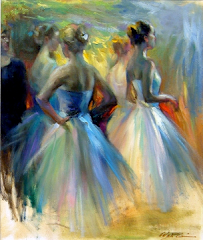
Varnish is used on top of oil or acrylic paintings, in the former case to help prevent the oils yellowing, and in both cases to a different sheen (matte or glossy) to the finished painting. Varnish on a painting that will not be under glass also protects it from damage by dirt, dust, and pollution.
Putting varnish on a painting is not something that can be rushed. The paint must be completely dry. For an oil painting that can take several to six months depending on the paint.
Read more!
Showing posts with label Acrylics. Show all posts
Showing posts with label Acrylics. Show all posts
Thursday, April 3, 2008
Varnish


Thursday, March 27, 2008
More on Acrylics
Acrylic paints can basically go on any surface. Traditionally, wood, canvas, and masonite are used. Some artists might use illustration board or paper, however if too lightweight of paper is used it can buckle from the liquid in the paint.
Acrylic mediums can alter the appearance, hardness, flexibility, texture, and other characteristics of acrylic paint. If an artist wants texture in acrylic paintings, he adds texturing mediums which thicken the paint and allow it to dry in different ways such as crinkly surfaces, rough sandy edges, or stiff peaks.
Acrylics are useful in mixed media as when once dry, artists can use pastels, charcoal, or pen on top of the dry surface.
Acrylic paints were invented about 50 years ago, so they have not had the test of longevity that oil paints have had, but so far they seem to yellow less.
Read more!
Thursday, March 20, 2008
Acrylics
Unlike oils, acrylic paints dry really fast. There are advantages and disadvantages to this quality. Quick drying can obviously speed up the painting process. Yet, too quick drying might make it difficult to achieve some effects, such as blending of two colors on the painting itself.
Acrylics can be thinned with water and acrylic medium. Acrylic clean up is easier – no solvents needed. There is also less odor when painting with acrylics.
More on this topic next week.
Meanwhile here are some of our artists that work in acrylics: Ursula Brenner, Cathy Kline, Gloria Coker, Ashley Dietrich, Alexandra Kruglyak, R.F. Tapnio, Christina Cena, & Yvonne Mora.
Read more!
Wednesday, January 2, 2008
Glazes
A technique some artists use is glazing. It can be done with oil, acrylic, or watercolor paints.
The basic of glazing is painting a very thin layer of paint on top of a dry painting, letting the glaze dry, then painting another layer, adding as many layers until the desired result is reached. Glazing can provide deepness, luminosity, and richness to a painting. It can be done over all of a painting or only on points of focus.
Others of our artists who do oil painting:
Penelope Moore
Jon Smith
Diana Dean
Read more!
Wednesday, November 28, 2007
Paint surfaces
A friend of mine paints art directly on the walls in her house. She also uses canvases, paper, and clothing for more portable art. I’ve also seen art painted on about any surface you can imagine—wood, metal, seashells, rocks, ceramic, plastic, etc. Much of fine art, however, is done on a stretched canvas. But what does that term mean exactly?
A stretched canvas is usually cotton or linen fabric that is literally stretched taut over a wooden frame. The frame pieces are called stretchers. Stretcher bars can be equal lengths to create a square or two sets of different lengths to create a rectangle. Before painting is done, the canvas is primed. (I’ll discuss this another time.)
Canvases can be purchased stretched and primed or some artists stretch and prime their own. This can be cheaper, but also allows for the exact size of canvas the artist desires.
Canvases are generally used for oil painting or acrylics.
Sometimes beginning artists use less expensive canvas board, which is primed canvas stretched over stiff paperboard.
Read more!
Subscribe to:
Posts (Atom)