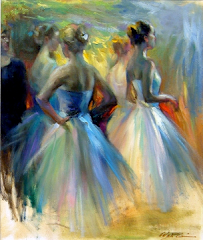
Varnish is used on top of oil or acrylic paintings, in the former case to help prevent the oils yellowing, and in both cases to a different sheen (matte or glossy) to the finished painting. Varnish on a painting that will not be under glass also protects it from damage by dirt, dust, and pollution.
Putting varnish on a painting is not something that can be rushed. The paint must be completely dry. For an oil painting that can take several to six months depending on the paint.
Read more!
Showing posts with label Oil painting. Show all posts
Showing posts with label Oil painting. Show all posts
Thursday, April 3, 2008
Varnish


Wednesday, January 23, 2008
impasto

The term, impasto, is borrowed from the Italian. It commonly refers to the oil painting technique where paint is thickly laid on the canvas. Brush strokes or painting knife strokes are often visible when this technique is used.
Impasto painting provides texture. Impasto gives the artist more control over the way light will reflect on the painting. Some say the paint is coming “out” of the canvas since it is almost a 3 dimensional sculpture.
Vincent van Gogh’s Sunflowers (pictured) used this technique.
Impasto painting provides texture. Impasto gives the artist more control over the way light will reflect on the painting. Some say the paint is coming “out” of the canvas since it is almost a 3 dimensional sculpture.
Vincent van Gogh’s Sunflowers (pictured) used this technique.
Read more!
Wednesday, January 16, 2008
Drying Oils or Mediums
Drying oils or mediums are added to oil paint to modify the way the paint handles or to change the characteristics of the paint—make it glossy or matt, transparent or opaque.
Linseed oil is used to add gloss and transparency to paint, although it has a tendency to yellow. A thicker processed form of linseed oil is called “stand oil.” It’s often used for glazing. Linseed oil can also be sun-thickened or sun-bleached. These three forms yellow less.
Poppyseed oil and safflower oil are pale oils that are more transparent and less likely to yellow than linseed oil. They dry more slowly.
Walnut oil is used to make oil paint more fluid. It also yellows less than linseed oil, but is expensive.
Boiled oils are faster drying and give a glossy finish, but tend to yellow and darken with age.
Read more!
Wednesday, January 9, 2008
Oil Painting: Solvents and Resins
Solvents are used to dilute oil paints or to dissolve resins. Solvents in oil paint will evaporate totally when the oil paint dries. Common solvents are: turpentine and minerals spirits. Both must be used in a well ventilated room and are flammable so precautions should be used.
Resins are used to increase the gloss of oil paint. They can also reduce the color and add body. A common resin is Damar. Damar is also used as a varnish.
Read more!
Wednesday, January 2, 2008
Glazes
A technique some artists use is glazing. It can be done with oil, acrylic, or watercolor paints.
The basic of glazing is painting a very thin layer of paint on top of a dry painting, letting the glaze dry, then painting another layer, adding as many layers until the desired result is reached. Glazing can provide deepness, luminosity, and richness to a painting. It can be done over all of a painting or only on points of focus.
Others of our artists who do oil painting:
Penelope Moore
Jon Smith
Diana Dean
Read more!
Wednesday, December 26, 2007
Fat over lean
This is an oil painting concept that basically prescribes slower drying paints (fat) over quicker drying paints (lean). This is not about thick paint versus thin paint. Lean oil paint is paint mixed with fast-drying oil and/or turpentine. Fat oil paint comes straight out of the tube or has additional oil added. Upper layers of paint shouldn’t dry faster than lower ones. The more oil the slower, the drying time.
Following the practice of “fat over lean” reduces the risk of an oil painting cracking.
More of our oil paint artists are:
Child Portraiture – Bob Byerley
Modern Urbanscape – Peggy Nichols
Still Life and Landscape – Chuck Rosenthal
Read more!
Wednesday, December 19, 2007
Blocking in
One technique some artists use is to “block in” the colors of their painting. This can be a loose painting of the dominant colors in the areas of the canvas where those colors will be. Or it may be the background colors in each appropriate section for a painting.
Here are several examples of what it looks like:
This article and photos by Marion Boddy-Evans is broken down into steps, with steps 1 and 2 being about blocking in: “Landscape Painting: Quiver Tree Step by Step.”
And this watercolor demonstration by Roger Simpson is quite interesting.
Here are a few of our artists, who do oil painting.
Jean Miller Harding – still life paintings
Yuri Klapoukh – portraiture and landscape paintings
Renee DiNapoli – floral paintings
Read more!
Wednesday, November 28, 2007
Paint surfaces
A friend of mine paints art directly on the walls in her house. She also uses canvases, paper, and clothing for more portable art. I’ve also seen art painted on about any surface you can imagine—wood, metal, seashells, rocks, ceramic, plastic, etc. Much of fine art, however, is done on a stretched canvas. But what does that term mean exactly?
A stretched canvas is usually cotton or linen fabric that is literally stretched taut over a wooden frame. The frame pieces are called stretchers. Stretcher bars can be equal lengths to create a square or two sets of different lengths to create a rectangle. Before painting is done, the canvas is primed. (I’ll discuss this another time.)
Canvases can be purchased stretched and primed or some artists stretch and prime their own. This can be cheaper, but also allows for the exact size of canvas the artist desires.
Canvases are generally used for oil painting or acrylics.
Sometimes beginning artists use less expensive canvas board, which is primed canvas stretched over stiff paperboard.
Read more!
Tuesday, November 20, 2007
Wei Tai
Traveling? Our featured artist, Wei Tai, will be participating in the Arizona Fine Art Expo, January through March of 2008. Click here for more information.
If your travels are limited to internet surfing, see more of Wei Tai’s work online, “Artist’s Magazine” shows their contest winners, plus a discussion of each painting.
The Artist's Magazine's 2000 Art Competition: Still Life
The Artist's Magazine's 2000 Art Competition: Landscape
In each category, scroll down to Wei Tai’s Honorable Mention to see the art and read about it.
And, of course, you can always go to the artist’s website directly to see more beautiful art.
Read more!
Wednesday, November 14, 2007
Oils, not just a tube of paint
I’m not an artist myself, although both of my daughters are very artistic and through the years have created beautiful works of art in a number of media. This has given me a small intro into the world of art.
So instead of sharing my very limited knowledge on oils, I thought I’d find good resources online.
Marion Boddy-Evans has some good articles on About.com.
This article is clear and concise: “Drying Oils or Mediums Used in Oil Painting.” A companion article is “Oil Painting: Solvents and Resins”
This article by Alina Bradford, “Oil Painting Tips and Terms,” is aimed at someone wanting to learn to paint, but I found it of interest in understanding some of the steps that an artist might go through in their painting.
Many of the artists we feature at the gallery, paint in oils.
Read more!
Subscribe to:
Posts (Atom)