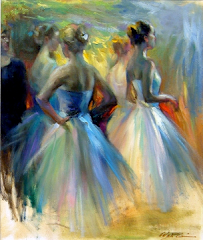
Layering is a technique used in watercolor as well as in other types of paintings. A wash has to completely dry before more can be done such as adding details on top. Or a glaze may be put over a wash. Similar to a wash, a glaze uses a thin transparent pigment. It could be used to adjust color and tone of the underlying wash. Multiple glazes can be used as long as each layer is allowed to dry thoroughly.
Another technique is “dropping in color.” A color is introduced to a wet region of a painting and allowed to bleed and feather without being touched by the artist. The results are unpredictable, but interesting.
Watercolor can be dissolved and removed or “lifted off” after it has dried, although not all colors allow this technique. The way it is done is by using a brush with clean water on the area, then blotting with a tissue. Sometimes an area will be masked before this is attempted.
Read more!
Thursday, April 24, 2008
More watercolor technique


Thursday, March 13, 2008
Painting techniques
In an earlier entry I talked about blocking in. Of course, there are other painting techniques.
Some artists paint over a detailed drawing they’ve done. Others prefer to paint one section at a time. They might complete individual objects before moving on to another item. One might paint the background first, then add the details on top. Another artist might paint the details and add the background afterwards.
When the painting is done, can you tell how it was done? Doubtful for the untrained eye, though it depends on what type of paint was used. Since acrylics and oils have texture to the paint, if one paint is painted on top of another that obviously will be more visible.
Read more!
Wednesday, January 23, 2008
impasto

Impasto painting provides texture. Impasto gives the artist more control over the way light will reflect on the painting. Some say the paint is coming “out” of the canvas since it is almost a 3 dimensional sculpture.
Vincent van Gogh’s Sunflowers (pictured) used this technique.
Read more!
Wednesday, January 9, 2008
Oil Painting: Solvents and Resins
Solvents are used to dilute oil paints or to dissolve resins. Solvents in oil paint will evaporate totally when the oil paint dries. Common solvents are: turpentine and minerals spirits. Both must be used in a well ventilated room and are flammable so precautions should be used.
Resins are used to increase the gloss of oil paint. They can also reduce the color and add body. A common resin is Damar. Damar is also used as a varnish.
Read more!
Wednesday, January 2, 2008
Glazes
A technique some artists use is glazing. It can be done with oil, acrylic, or watercolor paints.
The basic of glazing is painting a very thin layer of paint on top of a dry painting, letting the glaze dry, then painting another layer, adding as many layers until the desired result is reached. Glazing can provide deepness, luminosity, and richness to a painting. It can be done over all of a painting or only on points of focus.
Others of our artists who do oil painting:
Penelope Moore
Jon Smith
Diana Dean
Read more!
Wednesday, December 26, 2007
Fat over lean
This is an oil painting concept that basically prescribes slower drying paints (fat) over quicker drying paints (lean). This is not about thick paint versus thin paint. Lean oil paint is paint mixed with fast-drying oil and/or turpentine. Fat oil paint comes straight out of the tube or has additional oil added. Upper layers of paint shouldn’t dry faster than lower ones. The more oil the slower, the drying time.
Following the practice of “fat over lean” reduces the risk of an oil painting cracking.
More of our oil paint artists are:
Child Portraiture – Bob Byerley
Modern Urbanscape – Peggy Nichols
Still Life and Landscape – Chuck Rosenthal
Read more!
Wednesday, December 19, 2007
Blocking in
One technique some artists use is to “block in” the colors of their painting. This can be a loose painting of the dominant colors in the areas of the canvas where those colors will be. Or it may be the background colors in each appropriate section for a painting.
Here are several examples of what it looks like:
This article and photos by Marion Boddy-Evans is broken down into steps, with steps 1 and 2 being about blocking in: “Landscape Painting: Quiver Tree Step by Step.”
And this watercolor demonstration by Roger Simpson is quite interesting.
Here are a few of our artists, who do oil painting.
Jean Miller Harding – still life paintings
Yuri Klapoukh – portraiture and landscape paintings
Renee DiNapoli – floral paintings
Read more!