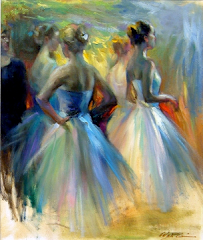
The paper used for watercolor painting is a specialty heavy paper at least 90lb. (To give you an idea of the thickness, standard card stock is 60 or 80lb.) Heavier, thicker, paper, such as 140lb, will buckle less from the moisture used during the painting process.
Watercolor paper ranges from inexpensive (thick paper with texture) to expensive watercolor paper (cotton paper). It comes in two varieties: hot press (smooth) and cold press (bumpy).
Watercolor paper is sold in single sheets, in a pad or a block. Single large sheets are sold for artists to cut their own smaller sheets. A block of watercolor paper is sealed on all sides, which keeps the paper rigid.
Read more!
Showing posts with label Watercolor. Show all posts
Showing posts with label Watercolor. Show all posts
Thursday, May 1, 2008
Watercolor paper


Thursday, April 24, 2008
More watercolor technique
Layering is a technique used in watercolor as well as in other types of paintings. A wash has to completely dry before more can be done such as adding details on top. Or a glaze may be put over a wash. Similar to a wash, a glaze uses a thin transparent pigment. It could be used to adjust color and tone of the underlying wash. Multiple glazes can be used as long as each layer is allowed to dry thoroughly.
Another technique is “dropping in color.” A color is introduced to a wet region of a painting and allowed to bleed and feather without being touched by the artist. The results are unpredictable, but interesting.
Watercolor can be dissolved and removed or “lifted off” after it has dried, although not all colors allow this technique. The way it is done is by using a brush with clean water on the area, then blotting with a tissue. Sometimes an area will be masked before this is attempted.
Read more!
Friday, April 18, 2008
Watercolor Painting
Watercolor painting has its own challenges. If you look at watercolor paper, you’ll see it is very thick so it can stand the amounts of water used without warping (at least warping too much).
Some painting styles require the watercolor paper to be dampened before any paint is applied. This technique is used for a “flat wash.” In this case a single pigment is spread in horizontal bands. The paper is laid on a sloping surface so that the paint will even itself out as it dries.
“Wet in wet” uses paint applied to a wet surface. This allows for easy blending of colors on the artwork, including intentional blurring.
Other times, paint is applied to dry paper. Paint may be applied with a dry brush followed up with a wet brush to give what is called Lost and Found edges (lost is soft, found is hard) or applied with a dry brush either to give sharp focused lines or the brush used at an angle so that the pits of the watercolor paper stay unpainted.
More next week.
Read more!
Wednesday, January 2, 2008
Glazes
A technique some artists use is glazing. It can be done with oil, acrylic, or watercolor paints.
The basic of glazing is painting a very thin layer of paint on top of a dry painting, letting the glaze dry, then painting another layer, adding as many layers until the desired result is reached. Glazing can provide deepness, luminosity, and richness to a painting. It can be done over all of a painting or only on points of focus.
Others of our artists who do oil painting:
Penelope Moore
Jon Smith
Diana Dean
Read more!
Wednesday, December 19, 2007
Blocking in
One technique some artists use is to “block in” the colors of their painting. This can be a loose painting of the dominant colors in the areas of the canvas where those colors will be. Or it may be the background colors in each appropriate section for a painting.
Here are several examples of what it looks like:
This article and photos by Marion Boddy-Evans is broken down into steps, with steps 1 and 2 being about blocking in: “Landscape Painting: Quiver Tree Step by Step.”
And this watercolor demonstration by Roger Simpson is quite interesting.
Here are a few of our artists, who do oil painting.
Jean Miller Harding – still life paintings
Yuri Klapoukh – portraiture and landscape paintings
Renee DiNapoli – floral paintings
Read more!
Subscribe to:
Posts (Atom)